

Roundtable Discussion: Clean and Equitable Energy Transition at Local Level
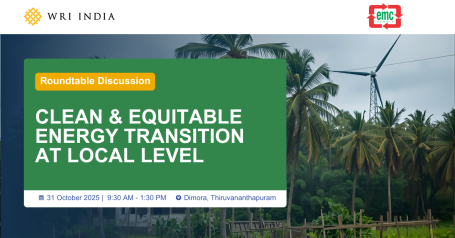
The local governments in Kerala have played a key role in shaping the state's developmental landscape across all sectors, most notably in health, education, and waste management. This decentralized approach has been instrumental in enabling equitable development and ensuring that progress reaches all sections of society.
As Kerala aspires to become a 100 percent renewable energy state by 2040 and achieve net zero emissions by 2050, decentralized energy generation becomes a vital component of this transition. Local governments are expected to play a crucial role in Kerala’s energy transition scenario.
While a few local bodies are already leading clean energy interventions, a larger number of local governments are yet to explore their full potential and actively participate in the energy transition.
Preliminary findings from a recent study conducted by Navakeralam Karmapadhathi and WRI India, covering 1,120 buildings across 92 local bodies, revealed a potential for nearly 8 Lakhs units of annual energy savings and 12 megawatts of rooftop solar capacity. This translates into a significant opportunity across all local governments in Kerala. Enhancing awareness and ensuring incentives can support and accelerate clean energy interventions at local level.
Furthermore, Kerala’s transition to clean energy must be rooted in equity to effectively respond to the state’s acute vulnerability to climate change. Equitable energy transition at its core is aimed at ensuring that the economic and social benefits of transition are shared by all. Local governments serve as the primary interface with the people and play a quintessential role in participatory and inclusive planning. Streamlining inclusive planning processes and integrating energy, equity and climate resilience goals into local development plans.
Among other efforts, a system that tracks and highlights energy-related initiatives while integrating equity considerations can significantly enhance and accelerate the energy transition efforts of local governments.
In view of this, Energy Management Centre (EMC) and the State Planning Board, in collaboration with WRI India, are working together to develop a framework to track the various clean energy interventions by the local governments.
In this regard, a roundtable discussion is being planned to gather input from multiple stakeholders. The discussions will also focus on the different aspects of the current gaps in the annual proposal guidelines for LSGs in clean energy, and the need to strengthen local capacity.
Key Speakers:
- Dr T N Seema, Co-ordinator, Navakeralam Karmapadhathi*
- Dr K Raviraman, Member (Energy), State Planning Board*
- Dr Jiju P Alex, Member (LSG), State Planning Board*
- Dr Mini Sukumar, Member, State Planning Board*
- Dr R Harikumar, Director, Energy Management Centre*
- Dhilon Subrahmanian, Senior Manager, WRI India
- Ijas M A, Senior Research Associate, WRI India (moderator)
- Chandana Sasidharan, Program Research Fellow, WRI India (moderator)